
SEMI E116 (EPT) Overview
Introduction
SEMI E116 Equipment Performance Tracking (EPT) is a key standard in semiconductor manufacturing. The core goal of this standard is to enable production equipment to automatically and continuously track the basic performance status of itself and key modules without relying on additional input from the operator or the host computer, providing a reliable data basis for the refined management and efficiency improvement of the factory. E116 provides the following specifications for equipment suppliers:
- Track basic equipment status (no operator or host input required).
- Track basic equipment status in a modular fashion, including major modules and overall equipment.
- Report changes in basic equipment status to the host at the module and equipment level.
- Report the time of equipment status to the host at the module and equipment level.
Terminology
- EFEM – Equipment Front End Module, mainly used for loading/unloading materials.
- Module – The main part of the equipment that contains at least one material location and performs certain tasks on the material. A equipment module may be an aggregation of equipment subsystems, I/O equipments, and other modules. (Definition from SEMI E98)
- EPT Module – The main component of a equipment that affects processing or throughput. To simplify operations, the EPT module can only perform one task at a time. Each EPT module has an EPT state model maintained by the equipment.
- EPT State – The IDLE, BUSY, or BLOCKED states in the EPT state model.
- Task – A planned, repeatable activity with an expected duration and a clear beginning and end (e.g., moving the wafer from the box to the workbench, pre-aligning the wafer, aligning the tick marks, warming up the chamber, adding a vacuum). Note: Actual durations may vary.
- Trigger – An event that triggers a change in the state of the equipment. Examples include changes in sensor readings, alarms, and messages received from the host, as well as operational commands.
- User – Any entity that interacts with the equipment, either a local operator or remotely via the host computer. (Definition from SEMI E58)
EPT State Model
The equipment performance tracking state model, which is applied to the equipment and its EPT module, aims to capture the different states of the equipment and its EPT module from an operational point of view. EPT modules are divided into two types: (1) production-based EPT module, and (2) EFEM/LoadPort EPT module. Both types have a module-level EPT state model.
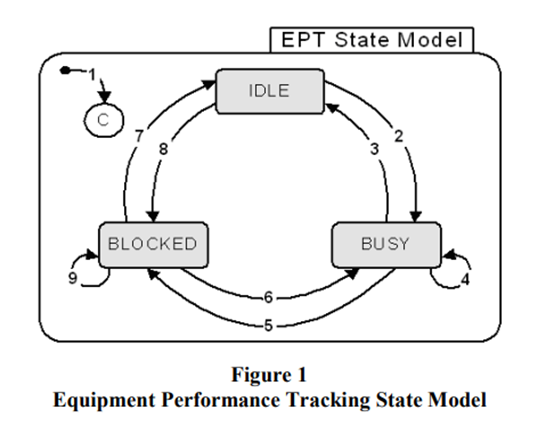
(Source: SEMI E116)
- IDLE: No material, no task performed, no failure to prevent new tasks from starting.
- BUSY: A task is being executed and there are no failures preventing it from executing.
- BLOCKED: Unable to start or continue a task due to a fault, pause/abort instruction, failed initialization, or waiting for external conditions.
EPT Status of the Equipment and Modules
The equipment shall maintain an independent EPT status model for any major component in the equipment that affects processing and throughput. The equipment shall maintain an EPT condition model of the overall equipment.
- The equipment state is the logical combination of the states of all its EPT modules.
- Equipment BUSY: At least one module is performing a task of type 1-5 (refer to SEMI E116 definition for task type).
- Equipment IDLE: Task modules of type 1-5 that do not have a blocking module preventing new tasks from starting and are not BUSY.
- Equipment BLOCKED: A task module of type 1-5 that is not BUSY and has at least one BLOCKED module that prevents the task from starting or completing.
EPT reports tasks with an explicit type attribute (TaskType, PreviousTaskType):
- 0 = No Task
- 1 = Unspecified
- 2 = Process
- 3 = Support
- 4 = Maintenance
- 5 = Diagnostics
- 6 = Waiting
EPTTracker Object Attributes
EPTTracker is one of the standard E39 object types. Here are some of the important properties of an EPTTracker object:
| Property Names | Definition |
| ObjID | The identifier for this EPT object. In E116, this refers to the unique identifier assigned to the EPTTracker object in the equipment. |
| ObjType | The type of this object. In E116, this is the fixed value “EPTTracker”. |
| BlockedReason | The reason for the EPTTracker object’s last Blocked condition, represented by a defined number. For example, 0 is Not Blocked, 2 is Safety Threshold, and so on. 7 to 9 are reserved for user-defined conditions. |
| BlockedReasonText | A text description of the reason for the EPTTracker object’s most recent Blocked condition. Can provide more information than a BlockedReason. |
| DisableEventOnTransition | A list of EPT state transitions #1 through #9. If a state transition in the list occurs for an EPTTracker object, event reporting to the Host will be disabled. |
| EPTElementType | Numeric code for the EPTTracker object type, 0,1,2 for Equipment, Production EPT Module, and EFEM/LoadPort EPT Module, respectively. |
| EPTState | EPTTracker object’s current EPT status. 0 = Idle 1 = Busy 2 = Blocked |
| EPTStateTime | EPTTracker’s holding time in the previous state before entering the current state. |
| EPTElementName | The name of the current EPT element, which needs to be unique across all EPTTracker objects. |
| PreviousEPTState | EPTTracker’s previous state before entering the current state. |
| PreviousTaskType | Name of the last task performed by the EPT module before starting the current EPT task. |
| TransitionTimeStamp | The timestamp of the EPTTracker object’s last EPT state change and triggered event. |
Summary
SEMI E116 EPT standard is a key tool to improve the transparency and productivity of semiconductor manufacturing equipment. It is adopted by:
- Mandatory equipment self-reporting: automatically and continuously provides equipment and module status, task details, and blocking reasons.
- Implement modular monitoring: Decompose complex equipment into manageable modules for status tracking.
- Provide accurate data: It lays a solid data foundation for calculating SEMI E10/E79 indicators, identifying bottlenecks, optimizing maintenance and improving overall equipment efficiency (OEE).
- Promote interface standardization: unified event and data variables are defined to simplify host integration.
For semiconductor plants pursuing smart manufacturing and operational excellence, implementing SEMI E116 compliant equipment is an indispensable step toward transparency of equipment performance, data-driven decision making, and continuous improvement.
To learn more about SEMI E116 solutions, please contact Support@kxware.com .
For SEMI E116 standard document, please visit the SEMI website: https://www.semi.org/en/products-services/download-standards