
SEMI E37 (HSMS) Overview
Introduction
The SEMI E37 High Speed SECS Messaging Service (HSMS) standard provides semiconductor equipment manufacturers with an efficient communication solution that enables seamless connectivity and interoperation between different equipment without deep knowledge of each other’s implementation details. HSMS is designed to replace the traditional SEMI E4 (SECS-I) protocol and is suitable for scenarios where higher communication speeds are required or simple point-to-point topologies cannot meet the requirements. SEMI E4 can still be used in other application scenarios where HSMS features are not required. The main contents included in SEMI E37 are: HSMS messaging service term definitions, HSMS state machines and interaction scenarios, and HSMS message structures.
Terminology
- Connection: A logical connection between two entities established on a TCP/IP LAN to exchange messages.
- Entity: The application associated with the endpoint of a TCP/IP connection.
- Initiator: The entity requesting the HSMS service by sending the appropriate HSMS message.
- Receiver: The HSMS entity that receives the message.
- Remote Entity: A remote entity is an entity associated with another endpoint of a connection, relative to one particular endpoint of the connection.
- Local Entity: Relative to a particular endpoint of a connection, a local entity is the entity associated with that endpoint.
- Message: A complete unit of one-way communication, consisting of message length, message header, and message text. HSMS messages can be data messages or control messages.
- Session: A relationship established between two entities for the exchange of HSMS messages.
- Session ID: A 16-bit unsigned integer that identifies a particular session for a particular session entity.
HSMS State Model
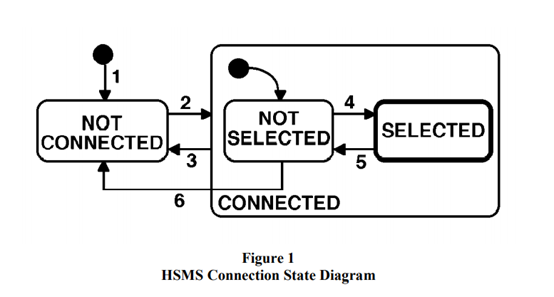
(Source: SEMI E37)
NOT CONNECTED: The entity is ready to listen to or initiate a TCP/IP connection, but no connection has been established yet.
CONNECTED: A TCP/IP connection has been established; it contains two sub-states: NOT SELECTED and SELECTED.
- NOT SELECTED-CONNECTED: A substate in which no HSMS session has been established or any previously established HSMS sessions have ended.
- SELECTED: A substate of SELECTED-CONNECTED in which at least one HSMS session has been established. This is the normal “operational” state of the HSMS: data messages can be exchanged in this state. It is highlighted in the statechart.
HSMS Timeout
- T3: HSMS protocol reply timeout.
- T5: Connection separation timeout, used to prevent excessive TCP/IP connection activity.
- T6: Control Interaction timeout, which defines the maximum amount of time an HSMS control interaction can remain open before a communication failure is considered to have occurred.
- T7: Connection Idle timeout, which defines the maximum time that can occur between the establishment of a TCP/IP connection and the use of that connection for HSMS communication before a communication failure is considered to have occurred.
- T8: Network inter-character timeout, which defines the maximum time that can occur between the receipt of any two consecutive bytes of a complete HSMS message before a communication failure is considered to have occurred.
HSMS Transaction Specification:
E37 specifies a set of interaction flows between equipment and host at the protocol layer, including:
- Establishing a TCP/IP connection: The procedure is defined in RFC 793, and HSMS restricts entities to either passive or active mode.
- Terminating a TCP/IP connection: Terminating a connection is the reverse logic of establishing a connection, and HSMS only allows terminating a connection when it is in the NOT SELECTED substate of the CONNECTED state.
- Select: Used to establish HSMS communication based on the use of Select.req and Select.rsp in control interactions over TCP/IP connections
- Concurrent Select: If the subsidiary standard does not restrict the use of Select, two entities may launch Select steps with the same Session ID at the same time. In this case, each entity should accept the other entity’s Select request by responding with select.rsp.
- Data message interaction: As long as the connection is in the SELECTED state, either entity can initiate HSMS data messages. Data messages can be further defined as part of data interaction
- Deselect: The Deselect step is used to provide a graceful end to HSMS communication before terminating the TCP/IP connection
- LinkTest: Linktest is used to determine the operational integrity of TCP/IP and HSMS communication. Linktest can be used at any time in the CONNECTED state
- Separate: The Separate step is used to abruptly terminate an entity’s HSMS communication before terminating the TCP/IP connection. When using Separate, HSMS requires the connection to be in the SELECTED state.
- Reject: Used in response to a valid HSMS message received in an inappropriate context.
HSMS Message Format
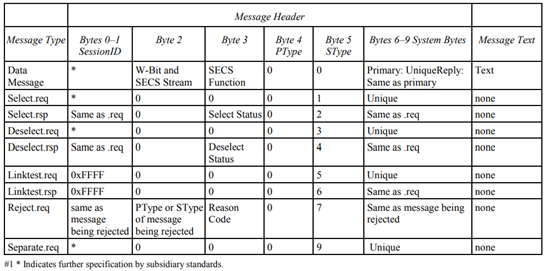
HSMS messages are transmitted as a single continuous stream of bytes in the following order:
- Message Header: A 10-byte field containing Session ID, Header Byte 2, Header Byte 3, PType, SType, and System Bytes.
- Message Text: Contains the actual data content.
The E37 summary of the parameters in the message header is shown below.
(Source: SEMI E37)
Parameter Setting Recommandation
E37 HSMS communication protocol parameters include timeout settings such as T3, T5, T6, T7, T8, HSMS connection mode, local and remote IP addresses. As the protocol specification for the communicating parties, SEMI E37 gives the parameter setting suggestions for the equipment side and the host side respectively.
- Equipment side suggested parameter settings
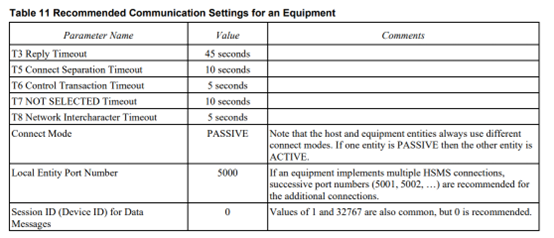
(Source: SEMI E37)
- Host side suggested parameter settings
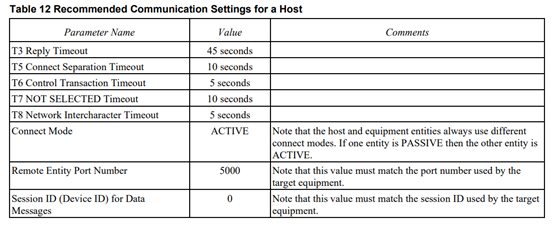
(Source: SEMI E37)
Subsidiary Standards
- SEMI E37.1-0819: High-speed SECS Messaging Service Single Session Mode (HSMS-SS) specification.
- SEMI E37.2-95 (Withdrawn) : High Speed SECS Messaging Service Common Session Mode.
Summary
HSMS provides the semiconductor industry with an efficient and reliable communication protocol for application scenarios that require high-speed data transfer and complex topologies. By understanding the basic concepts, state machines, message formats, and parameter settings of HSMS, technicians can better achieve interoperability and communication efficiency between equipment.
To learn more about SEMI E37 solutions, please contact support@kxware.com.
For SEMI standards documents, please visit the SEMI site: https://www.semi.org/en/products-services/download-standards.