
SEMI E90 (STS) Overview
Introduction
In the semiconductor manufacturing process, the tracking and management of Substrate is a key link to ensure production efficiency and product quality. The SEMI E90 standard provides a unified service standard for Substrate tracking in manufacturing equipment. It defines the concepts and behaviors of Substrate, Substrate Location, Batch, and Batch Location. The SEMI E90 standard is applicable to any manufacturing equipment that handles substrates. The E90’s substrate service is always available from the moment the substrate is registered to the equipment to the moment it is removed from the equipment .
Terminology
Before diving into the E90 standard, it’s worth understanding the definitions of some key terms:
- Substrate: The basic unit of material used to produce a product, such as wafers, dies, Mask Plates, Circuit Boards, and Lead Frames.
- Substrate Carrier: A carrier used to carry a substrate, usually having one or more locations to house the substrate.
- Substrate History: An ordered set of information about the locations visited by the substrate.
- Substrate ID: A unique identifier for the substrate.
- Lot: One or more groups of the same type of substrate, organized by the user, for substrate tracking in the plant.
- Batch: A group of substrates processed at the same time in a process resource.
Substrate Tracking
SEMI E90 standard provides the following substrate tracking features:
- Substrate Location Tracking: Determines the current location of the substrate in the equipment to help users understand the environment of the substrate.
- Batch Location Tracking: Determines the current location of a set of substrates in a equipment and is suitable for batch processing equipment .
- Substrate History Record: Reads the history information of the substrates in the equipment , and users can query the access records of specific substrates.
- Substrate Process Tracking: To track the processing status of the current substrate, especially when the processing is not completed normally, the user can determine whether the substrate is processed by requesting the substrate status.
Substrate State Model
The E90 standard defines a substrate state model, which consists of three concurrent substrate states:
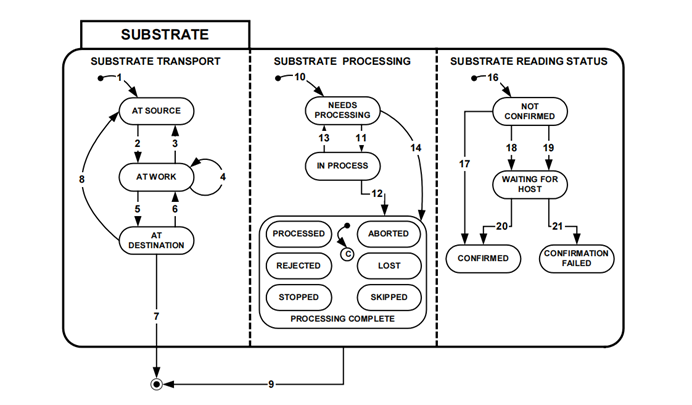
Substrate State Model (Source: SEMI E90)
- Substrate Transport State: Indicates the state of where the substrate is located, including AT SOURCE, AT WORK and AT DESTINATION.
- Substrate Processing State: Indicates the state of substrate PROCESSING progress, including NEEDS PROCESSING, IN PROCESS, PROCESSING COMPLETE, etc.
- Substrate Reading Status: If the equipment provides substrate information reading mechanism, the equipment should contain substrate reading status, such as NOT CONFIRMED, WAITING FOR HOST and CONFIRMED.
Material Location
- Substrate Location includes Equipment Substrate Location and Carrier Substrate Location.
- Batch Location is used to identify the location of a set of substrates, and each Batch Location object (BLO) on the equipment is assigned a batch location ID to uniquely identify it.
- Carrier Location: The location of the material in which the Carrier can be accommodated.
Substrate Location State Model
There are usually two types of Substrate Location on a equipment :
- Equipment Substrate Location: The substrate location on the equipment , is a persistent object.
- Carrier Substrate Location: A substrate location (e.g., Slot) within a Carrier that is dynamically created and deleted as the Carrier equipment is placed on or removed from the equipment .
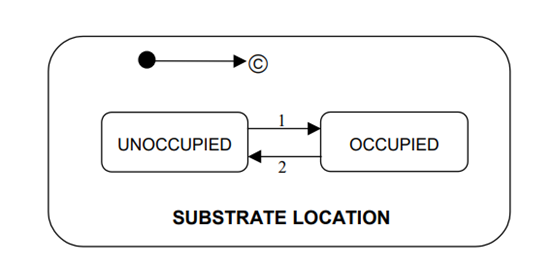
Substrate Location State Model (Source: SEMI E90)
The state of Substrate Location contains two sub-states UNOCCUPIED (the substrate location does not hold or has no substrate) and OCCUPIED (the substrate location holds the substrate).
Batch Location State Model
Batch Location Object (BLO) provides a model for identifying a set of substrate locations. Each BLO on the equipment is assigned a Batch Location ID to uniquely identify it. A Batch Location is a persistent object.
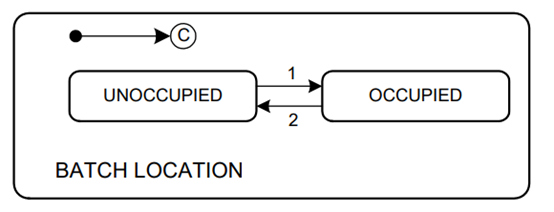
Batch Location State Model (Source: SEMI E90)
The state of a Batch Location contains two sub-states UNOCCUPIED (the Batch Location does not hold or own the substrate in any batch) and OCCUPIED (the Batch Location holds the substrate in one or more batches).
Creation and Destroy of Substrate Objects
The equipment can create substrate objects as needed during operation. Substrate objects can also be registered on the equipment through the create service defined in SEMI E39. When the create service is initialized, the attributes such as substrate location ID (SubstLocID), batch location ID (BatchLocID), and the location of the substrate in the batch (SubstPosInBatch) are provided.
Data Requirements and Events
The E90 standard requires equipment to provide corresponding data when substrate status changes, such as substrate ID status (SubstIDStatus), batch location ID (SubstBatchLocID), substrate history (SubstHistory), etc. In addition, a equipment with a substrate ID reader is required to provide the following events:
- SubstrateIDReaderAvailable: triggered when substrate ID reader available.
- SubstrateIDReaderUnavailable: when the base board ID reader is unavailable.
Summary
SEMI E90 standard provides a comprehensive specification for substrate tracking in semiconductor manufacturing equipment, covering substrate location, batch location, substrate status management, and other aspects. By following this standard, equipment manufacturers and software technicians can ensure that substrate information is accurately tracked and managed, thereby improving production efficiency and product quality.
To learn more about SEMI E90 solutions, please contact Support@kxware.com.
For more information about the SEMI E90 standard, please visit the SEMI website at http://www.semi.org.