
SEMI E30 (GEM) Overview
Introduction
SEMI E30 GEM (Generic Equipment Model) standard defines the behavior model of semiconductor manufacturing equipment in a SECS-II communication environment. This standard is intended to provide a set of general equipment behaviors and communication capabilities to support the automation programs of semiconductor equipment manufacturers. By implementing the GEM standard, equipment suppliers and plants are able to reap significant economic benefits.
The GEM standard contains two categories of requirements: basic features and additional features.
Basic functional requirements include:
- Communication State Model: Defines the communication rules and state transitions between the equipment and the host.
- Control State Model: Specifies the level of collaboration between the host and the equipment, and how the operator interacts at different levels of control.
- Processing State Model: Reports the operating status of the equipment and allows the equipment to customize the state.
- Collection Event Notification: When a meaningful event occurs on the equipment, it is reported to the host in real time.
- Identification: The equipment accepts authentication requests from the host while it is online.
- Error Messages: The equipment notifies the host when it receives a message that it cannot process.
- Documentation: Provides basic information and operating manuals for the equipment.
Additional feature requirements include:
- Dynamic Collection Event Reports: Allows hosts to dynamically modify equipment event reporting settings.
- Variable, Trace, Status Data: The host can request the equipment to report relevant data by specifying the variable ID.
- Self-Description: A equipment is able to provide the host with detailed information about its functionality and configuration.
- Alarms: The equipment reports to the host when an abnormal condition occurs.
- Remote Control: The host can remotely operate equipment through a communication interface.
- Equipment Constants: The host can read and change constant values on the equipment.
- Process Recipe Management: The method of passing process specifications between the host and the equipment.
- Material Movement: The equipment notifies the host when the material is transferred.
- Terminal Services: The host can display information on the equipment display or receive information from the equipment operator.
- Limit Monitoring: The host can monitor the values of equipment variables and receive notifications when the variables go outside the set range.
- Clock: The host can set and query the time of the equipment.
- Spooling: During a communication outage, a equipment can queue messages in a buffer to be delivered when communication resumes.
Communication State Model
The communication state model specifies the communication rules between the equipment and the host.
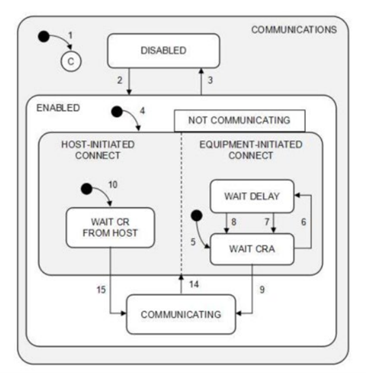
(Source: SEMI E30)
The states of a communication state model include:
- Disabled: The communication function is disabled.
- Enabled: The communication feature is enabled.
2.1 Not Communicating: No communication has been established between the equipment and the host.
2.1.1 Host-Initiated Connect: Host connection request.
Wait for CR from Host: Wait for the host to confirm the connection request.
2.1.2 Equipment-Initiated Connection: The equipment initiated a connection request.
2.1.2.1 Wait Delay: Wait for the communication delay timer to expire.
2.1.2.2 Wait for CRA: Wait for communication request acknowledgment.
2.2 Communicating: Equipment and host are in communication.
The core of the communication state model is the CommDelay Timer, which measures the interval time between attempts to send S1,F13 messages. The length of the timer can be configured by the user’s equipment constant EstablishCommunicationsTimeout.
Control State Model
The control state model defines the level of collaboration between the host and the equipment and specifies how the operator interacts at different levels of control.
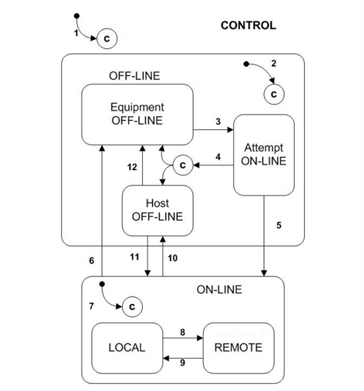
(Source: SEMI E30)
States include:
Online: The equipment is online and the host can control the equipment remotely.
- Local: The equipment is controlled locally by the operator, and the host cannot use remote commands that cause physical movement or start processing, but can upload and download recipes.
- Remote: The equipment is controlled remotely by the host computer, which has full control of the equipment, and the operator can only perform emergency operations.
Offline: The equipment is offline and the host cannot control the equipment. The operation of the equipment is carried out by the operator at the console; the host can only send messages.
In the Online/Remote state, the host has full control.
Process State Model
The process state model reports the operating status of the equipment and allows the equipment to customize the status. The states of the equipment may include:
- Init: The equipment is initialized.
- Idle: The equipment is idle.
- Processing Active: The equipment is processing.
- Pause: Processing is paused.
- Process: The process is in progress.
- Setup: The equipment is set up.
- Ready: Equipment is ready.
- Executing: The equipment is executing the task.
Collecting Event Notifications
Collecting event notifications is an important feature in the GEM standard. When a meaningful event occurs on the equipment, it is reported to the host in real time. GEM adopts a publish/subscription mechanism, where the equipment defines a set of events that can be collected by the host, and the host subscribes to the required events. When the event is triggered on the equipment side, the GEM interface only reports events that have been subscribed to.
The collection event is of great significance to the host. A collection event is a group of equipment events or individual events. Each collection event has a unique identifier, CEID. The host can monitor equipment status through event reports, trace reports, limit monitoring, and data inquiry status variables.
Dynamic Event Reporting
In actual production, the host needs not only to receive event notifications but also to know the data related to the event. The GEM standard allows hosts to dynamically modify equipment event reporting settings. The host can define a report, link the report to a collection event, and enable the collection event notification. Equipment publish requested data through collection event messages.
Variable Data Collection
The variable data collection function allows a host to request a report containing data variables from a equipment by specifying an RPTID. The values of the status variables and equipment constants included in the report must be up-to-date. Discrete data variable values are valid only when a specific collection event occurs.
Trace Data Collection
Trace data collection provides a method of sampling data on a regular basis. It applies to following trends or controlling continuous data within a certain time window. Trace reports contain information such as data sampling interval, report group size, status variables, total sample number, and trace ID.
Limit Monitoring
The limit monitoring feature allows the host to monitor the value of a equipment variable and receive a notification when the variable exceeds a set range. Limit monitoring involves defining a monitoring area and limits. When a variable’s value transitions between monitored areas, the equipment reports to the host.
Remote Control
The remote control function allows the host to operate equipment through a remote communication interface. The host can send commands, such as start processing, select recipe, stop, pause processing, resume processing, and abort. The equipment must respond to the host commands and provide the corresponding functions.
Equipment Constant Management
The equipment constant management function allows the host to read and change constant values on the equipment. Equipment constants should be stored in nonvolatile memory. When an operator changes an equipment constant, the equipment should provide a collection event to remind the host.
Process Recipe Management
The process recipe management function allows the transfer of process specifications between the host and the equipment. The equipment should support at least one defined process recipe management scheme, such as formatted or unformatted process recipe management. The host can upload, download, query, and delete process recipes.
Material Movement
The material movement function is used to notify the host of the presence or removal of material at an equipment port. The equipment shall provide at least two collection events for reporting material removal and material arrival.
Terminal Services
Terminal services allow hosts to display information on the equipment display, or to accept information from the equipment operator. The equipment shall be able to display the host’s message and transfer the information entered by the operator to the host.
Error Messages
When equipment receives a message it cannot handle, it shall notify the host of the error types, including the equipment ID, message stream type, message format, message function, and data format. The equipment should also notify the host when the amount of packet data exceeds its processing capacity or when the interactive timer expires.
Clock
The clock feature enables the host to manage time-related activities across multiple equipment. The host can set and query the time, and the equipment can also request the current time from the host. Timestamps are useful for determining the relative order in which events and alarms occur and for the host’s scheduling of equipment activity.
Spooling
The spooling feature allows a equipment to queue messages during a communication outage so that they can be delivered once communication is restored. The purpose of spooling is to retain data that might otherwise be lost due to communication failures, which can be used to track materials and improve product quality.
Summary
The SEMI E30 GEM standard provides a generic communication and control model for semiconductor manufacturing equipment, covering a full range of requirements from basic communication to advanced functions. By implementing the GEM standard, equipment suppliers and factories can significantly improve the efficiency and flexibility of manufacturing automation, resulting in greater economic benefits.
To learn more about SEMI E30 solutions, please contact support@kxware.com.
For SEMI standards documents, please visit the SEMI site: https://www.semi.org/en/products-services/download-standards.