
SEMI E4 (SECS-I) Overview
Introduction
SECS-I is a equipment communication foundation standard developed by SEMI in cooperation with the Japan Electronics Industry Development Association. It focuses on the physical and logical protocol layers of message transmission. The standard is based on a subset of EIA RS-232-C (or JIS C 6361) and is suitable for communication between various types of equipment such as wafer fabrication, processing, measurement, packaging, and a host computer.
SECS-I defines a complete interface specification, including connector types, electrical levels, data rates, and communication protocols, but not the message content, which is specified by SEMI E5 (SECS-II).
Physical Interface and Electrical Characteristics
SECS-I supports 9-pin or 25-pin D-type connectors and uses full-duplex serial communication. The electrical level conforms to the RS-232-C standard:
- Logic 1: ≤ -3V
- Logic 0: ≥ +3V
- Max voltage: ±25V
Optional power pins (pin 18 and 25 of the 25-pin connector) provide isolated power to external circuits, supporting a current of ≥50mA.
Standard data rates include 9600, 4800, 2400, 1200, 300 baud, with 19200 and 150 baud optional. Signal quality requires a bit error rate of less than 1×10⁻⁶.
Character Structure With Data Blocks
Data is transferred in 10-bit character units and includes:
- 1 start bit (0)
- 8 data bits
- 1 stop bit (1)
Data is organized in blocks of up to 254 bytes, each with a 10-byte header and up to 244 bytes of data. Messages can be composed of 1 to 32,767 blocks, and the maximum message length is about 7.99MB.
Block Transfer Protocol
SECS-I uses block transfer protocol to manage communication direction, conflict resolution and error recovery, and supports bidirectional asynchronous transmission. The protocol state includes:
- Idle
- Send
- Receive
- Line Control
- Complete
Handshake Mechanism:
- ENQ: Send request
- EOT: Ready to receive
- ACK: Receive correctly
- NAK: Incorrect reception
Timeout & Retry:
- T1: Timeout between characters
- T2: Protocol timeout (ENQ→EOT, etc.)
- RTY: Maximum number of retries. If exceeded, the transmission fails.
The checksum is 16 bits, calculated based on the header and data, and is used to detect transmission errors.
The Header Structure
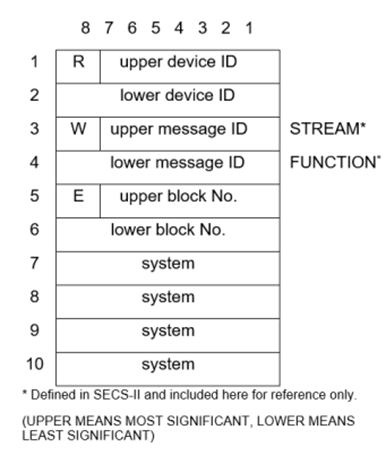
(Source: SEMI E4)
The header of each block is 10 bytes and contains the following key fields:
- R-bit: Message direction (0→ equipment, 1→ host)
- E-bit: Whether it is the last block of the message
- Devicd ID: 15 bits to identify the device
- W-bit: Whether to expect a reply
- Message ID: 15 bits, corresponding to Stream and Function in SECS-II
- Block number: Used for multi-block message sequence identification
- System bytes: 4 bytes for message association with reply
Message Protocol and Transaction Management
A message is a complete one-way unit of communication, consisting of headers and data. A transaction consists of a main message and an optional reply.
Message Handling Mechanism:
- Reply link: Start reply timer when W bit of main message =1 (T3)
- Duplicate block detection: This is achieved by comparing the headers of consecutive blocks
- Routing error: An error is declared when the device ID does not match
- Inter-block timeout (T4): A multi-block message with a block reception interval timeout cancels the message
Protocol Parameters and Documentation Requirements
The following parameters should be specified for SECS-I implementation:
- Device ID
- Timeout parameters T1 to T4
- The number of retries RTY
- Master/Slave roles (M/S)
- Block length (10 to 254 bytes)
The conformance document should specify the parameter setting method, the message length supported, whether multiple blocks and messages can be interleaved, and the maximum number of concurrent interactions.
Summary
As the underlying communication standard for semiconductor equipment, SECS-I provides a reliable and structured message transmission mechanism between equipmnet and hosts. Understanding the protocol details and parameter configuration is very important for the development of stable and efficient equipment communication systems. With the development of industrial communication networks, SECS-I still serves as the basis for many equipment interfaces and continues to support high-precision collaboration in semiconductor manufacturing.
To learn more about SEMI E4 solutions, please contact support@kxware.com.
For SEMI standards documents, please visit the SEMI site:
https://www.semi.org/en/products-services/download-standards.