
SEMI E5(SECS-II) Overview
Introduction
SEMI E5 SECS-II (Semiconductor Equipment Communication Standard 2) defines the detailed structure and interpretation of the messages exchanged between a semiconductor equipment and the plant host computer. The standard is fully compatible with SEMI E4 (SECS-I) and allows compatibility with other message transfer protocols. SECS-II supports typical behavior scenarios in IC manufacturing by defining the detailed structure of messages so that host software needs only minimal knowledge of individual equipmnet to establish communication. The main contents of SEMI E5 include the basic terminology and concepts of the communication protocol between the equipment and the host, the format and components of SECS-II messages, and the definition and specification of communication data items.
Terminology
- Host: An intelligent system that communicates with the plant’s equipment.
- Equipment: The intelligent system that communicates with the plant host.
- Device ID: A number between 0 and 32767 that identifies the particular equipment that is communicating with the host.
- Transaction: Forms the basis of all SECS-II information exchange and consists of a primary message that does not request a reply or a primary message that requests a reply and its corresponding secondary message.
- Conversation: A series of one or more related interactions used to accomplish a specific task. A session timeout is used to indicate that a session did not end normally.
- Primary Message: A message whose Function is odd and is also the first message of a pair of interactive messages.
- Secondary Message: A message whose Function is even. Also the second message of a pair of interactive messages.
- Single-block Message: SECS-II requires certain messages to be sent as a Single Block or a single packet in accordance with the Message Transport protocol. The maximum allowed length of a SECS-II message for a single block is 244 bytes.
- Multi-Block Message: SECS-II messages that are longer than 244 bytes are called multi-block messages. Certain SECS-II messages are allowed to be multi-block messages, even if they otherwise meet the single-block length requirement.
- Status Variable: Read-only status information whose value always contains valid information.
- Data Variable: Read-only information that only needs to contain valid information when the Event associated with the Data Variable is reported in an Event Report message.
- Equipment Constant: A setting for a equipment, this value can be set by the host and operator to configure the hardware or software behavior of the equipment.
SECS-II Message Definition
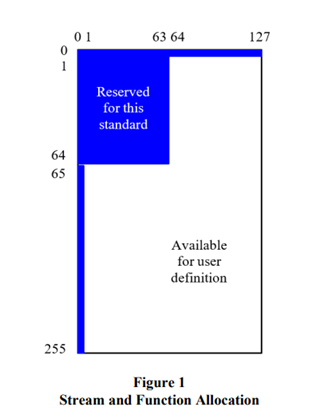
SECS-II messages are divided into streams, each of which contains a specific Function message. For example:
- Stream 1: Exchanges equipment status information.
- Stream 2: Processes equipment control messages from the host.
- Stream 3: Material Status, including information and actions related with material in system.
- Stream 4: Material Control, contains the original material control protocol and the new protocol to support SEMI E32.
- Stream 5: Exception Handling, contains messages about binary and analog equipment exceptions.
- Stream 6: Data collection, used for process measurement and equipment monitoring needs.
- Stream 7: Process Program Management, which is used to manage and transmit process programs.
- Stream 9: System error, used to notify the host that a message block that cannot be processed has been received or that a transaction timer timeout has occurred.
- Stream 10: Terminal Service, this set of messages is suitable for passing text messages between the operating terminal of the equipmentand the host.
- Stream 11: has been removed and will no longer appear in the E5 standard. The Communications Commission has unanimously concluded that Stream 11 is outdated. It has been removed from the 1989 version of the standard, discouraging its use.
- Stream 12: Wafer map graph that handles messages for coordinate locations and data associated with those locations. Includes such as the wafer map with the coordinates of the die on the wafer and associated binning information.
- Stream 13: Data Set Transfer, which provides a protocol for transferring data sets between systems.
- Stream 14: Object Service, this set of messages is used for common functions related to objects, including getting object information and setting object values.
- Stream 15: Recipe management, which defines a set of messages for interacting services defined by E139 with information and operations about recipes, recipe namespaces, and recipe executors.
- Stream 16: Process Management, which provides protocols for a set of messages that are able to control the processing of materials by equipment and equipment resources.
- Stream 21: (Data Item Transfer) Defines the messages used to transfer potentially large items between the host and the equipment.
A specification for the definition of equipment specific messages is specified in E5 to support behavior scenarios not covered in standard messages.
(Source: SEMI E5)
Message Structure
SECS-II messages are grouped into categories called Streams, and each Stream contains a specific Function message. A message consists of a data Item called an Item and a list of items, a structure that allows the use of a self-describing data format to ensure the correct interpretation of the message.
Message Header
A message transport protocol must provide the following information, called a message header, for each message. The information contained in the message header is:
- Device ID: A number between 0 and 32767 that indicates the source or destination of the message.
- Stream and Function: Messages are identified by a Stream number (0 to 127) and a Function number (0 to 255).
- Request Reply (W-bit) : The message transport protocol must be able to identify whether the primary message requires a reply.
Data items and lists
Data Item: A data element in a message whose length and format is defined by the first 2, 3, or 4 bytes of the Item. For example, <U4 1000454> represents an unsigned four-byte integer data item whose value is eventually parsed to 1000454.
List: An ordered collection of elements, which can be either an Item or a List.
The basic data types defined in E5 include: List, Binary, Boolean, I1, I2, I4, I8, U1, U2, U4, U8, F4, F8. E5 also specifies the data format used to pass localized string data items, such as Simplified Chinese GB.
Data Item Dictionary
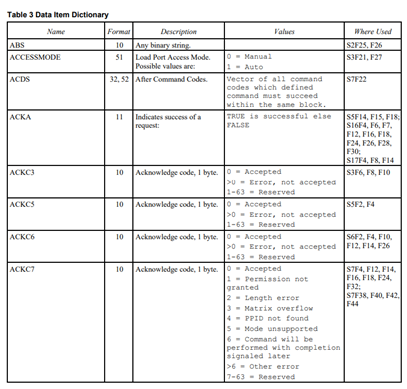
The data item dictionary in E5 is the specification of each data item of the message in E5, which restricts the data type, purpose and interpretation of the data in the communication message, and enumerates the scenarios in which the data item is used. For example:
(Source: SEMI E5)
Summary
The SEMI E5 SECS-II standard provides a detailed message structure and interpretation for communication between a semiconductor equipment and a host computer, supporting typical behavior scenarios in integrated circuit manufacturing. By understanding the basic concepts, message structures, interactions and sessions, data items and lists, and variable dictionaries of SECS-II, technicians can better achieve efficient communication between equipment and hosts.
To learn more about SEMI E4 solutions, please contact support@kxware.com.
For SEMI standards documents, please visit the SEMI site: https://www.semi.org/en/products-services/download-standards.