
SEMI E40 (PJM) Overview
Introduction
In the semiconductor manufacturing process, process management is a key link to ensure production efficiency and product quality. The SEMI E40 standard provides a unified specification of communication requirements for process management in semiconductor manufacturing environments, covering the concepts of material processing, equipment behavior, and messaging services required to complete tasks. This document introduces the core content of the SEMI E40 standard to help software technicians in the semiconductor industry better understand and apply this standard.
Overview
The SEMI E40 standard is designed to automate the management and command of material processes in semiconductor equipment, ensuring that materials delivered to the equipment are processed according to the correct formulation. The standard describes the concept and process model on which process management communication is based, and defines standard object properties and messaging services in detail.
Process Job
A Process Job is a dynamic object created by the process supervisor (Host or interface operator) to influence the processing of materials by the equipment. The core element of a process job is to execute “what processing technology” for “what material”. A process operation consists of at most four sequential stages:
- Pre-process treatment: Pre-process the equipment before the material arrives.
- Preparation of processing materials and equipment: prepare for material processing.
- Material processing: actual material processing.
- Post-processing: post-processing of the equipment after the material leaves, such as cleaning.
The life cycle of the process operation may exceed the actual processing time of the material, allowing the equipment to pre-process the material before receiving it and to post-process the material after it has been sent.
Process Job Object Attributes
- ObjID: The identifier of the object. In E40, it refers to the unique identifier of the process job to which the process job is assigned.
- ObjType: The type of object. In E40, the fixed value is “PROCESSJOB”.
- PauseEvent: A group identifier of the event. When any event occurs, the equipment will automatically switch the process job status to PAUSING/PAUSED state.
- PRJobState: The state in which the process job is located according to the definition in the E40 process job state model.
- PRMtlNameList: A list of identifiers of the material being processed.
- PRMtlType: The type of material being processed.
- PRProcessStart: Indicates whether the process operation starts the processing immediately after the material is ready.
- PRRecipeMethod: Indicates the recipe specification type. Two types are included: Recipe Only and Recipe with Variable Tuning.
- RecID: Recipe identifier for the processing application.
- RecVariableList: A list of process variables used to support the recipe method (PRRecipeMethod).
Process Tuning
Process tuning is becoming increasingly important in process stabilization, especially in processes that lack field measurements. The E40 standard provides a simple process adjustment mechanism that supports limited feedforward and feedback control. Two recipe methods are defined in the standard: Recipe Only and Recipe with Variables. The latter provides a list of variable names and values when a process job is created to support process adjustments.
Process Job Without Material
The E40 standard allows the application of process jobs to equipment that does not contain any material to be processed, and is used to achieve equipment adjustment independent of specific materials. This process operation has normal control characteristics but does not depend on material arrival and is terminated at the end of processing.
Process Job State Model
A process job is a transient entity that is created, executed, and eventually removed by the equipment at the request of the process supervisor (Host or interface operator). Each process job has an independent state model that includes the following states:
- QUEUED: The process job has been accepted by the equipment through the PR job create/confirm session and is waiting for execution.
- ACTIVE: The process job is in an active state, including the following sub-states:
- EXECUTING: The executing state of the process job, including SETTING UP, WAITING FOR START and PROCESSING sub-states.
- ABORTING: The processing resource is executing an ABORT or optional error recovery program. Aborting the process will cause the processing to terminate immediately. It is the responsibility of the equipment to stop physical activity as soon as possible after a safe state has been reached.
- STOPPING: The processing resource is executing the STOP procedure to terminate the processing in an orderly manner. It is the responsibility of the equipment to stop the current activity at the next safe and convenient point, maintaining the integrity of the material. For processing equipment, this may require sending all relevant material to its output destination. This means that each material is either processed the way specified in the recipe or not processed at all.
- PAUSING/PAUSED: Processing of the equipment’s material is tentative. Includes PAUSING and PAUSED two sub-states.
- POST ACTIVE: The final state of the process job, including the following sub-states:
- PROCESS COMPLETE: The equipment has finished processing all materials specified by the process job. When all materials are removed from the equipment, the equipment performs any required post-processing. Post-processing includes all operations required by the recipe in the equipment after the material leaves the equipment.
- STOPPED: The final state of a process operation that was once in the state of STOPPING.
- ABORTED: The final state of a process job that was once in the state of ABORTING.
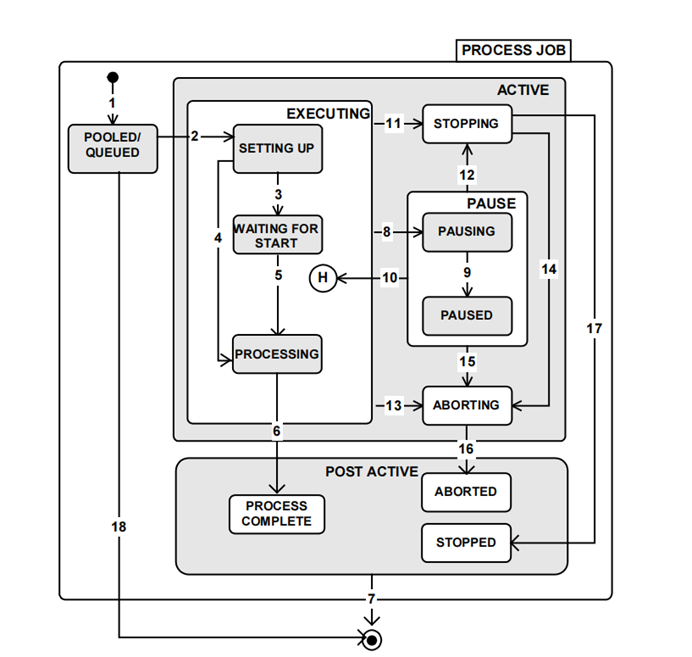
(Source: SEMI E40)
Process Job Services
The E40 standard defines a range of process job services, including:
- PRJobCreate (S16F3/F4): Creates process jobs.
- PRJobCommand (S16F5/F6): Used to send process operation commands, such as Abort, Stop, Cancel, Pause, Resume, and Start Process.
- PRJobAlert (S16F7/F8 or S6F11/F12): Used to notify process job milestone events.
- PRJobEvent (S16F9/F10 or S6F11): Used to notify process operation information events.
- PRJobCreateEnh (S16F11/F12): Creates a process job with more definable parameters than the PRJobCreate command.
- PRJobMultiCreate (S16F15/F16): Creates multiple process jobs.
- PRJobDequeue (S16F17/F18): Removes a process job from the queue.
- PRJobGetAllJobs (S16F19/F20): Returns a list of all outstanding jobs.
- PRJobGetSpace (S16F21/F22): Returns the number of remaining jobs that can be created for the equipment .
- PRJobSetRecipeVariable (S16F23/F24): Changes the setting of the recipe variable parameter list.
- PRJobSetStartMethod (S16F25/F26): Changes the start method of the job.
- PRJobSetMtrlOrder (S16F29/F30): Requests to use a specific policy for the material process order.
Summary
The SEMI E40 standard provides a comprehensive specification for process management in semiconductor manufacturing environments, covering the creation, control, tracking, and adjustment of process operations. By following this standard, equipment manufacturers and software technicians can ensure the accuracy and efficiency of material processing, thereby improving production efficiency and product quality.
To learn more about SEMI E40 solutions, please contact support@kxware.com.
For SEMI standards document, please visit the SEMI site: https://www.semi.org/en/products-services/download-standards.