
KXEDA SDK
The traditional SECS/GEM protocol multiplexes device control and data reporting over the same communication link. Due to performance limitations, data sampling rates are typically limited to 12 Hz, with acquisition logic tightly coupled to batch production processes, making it difficult to achieve high-frequency sampling, conditional triggering, or parallel access by multiple clients. The SEMI EDA/Interface-A standard decouples the data channel from the control channel, supporting self-describing device metadata, flexible and configurable data collection plans (DCP), and independent access by multiple clients. As an independent equipment data acquisition standard designed for semiconductor manufacturing facilities, EDA complements the traditional SECS/GEM protocol by focusing solely on data collection without involvement in device control. It has now become a mandatory interface requirement for advanced production lines.
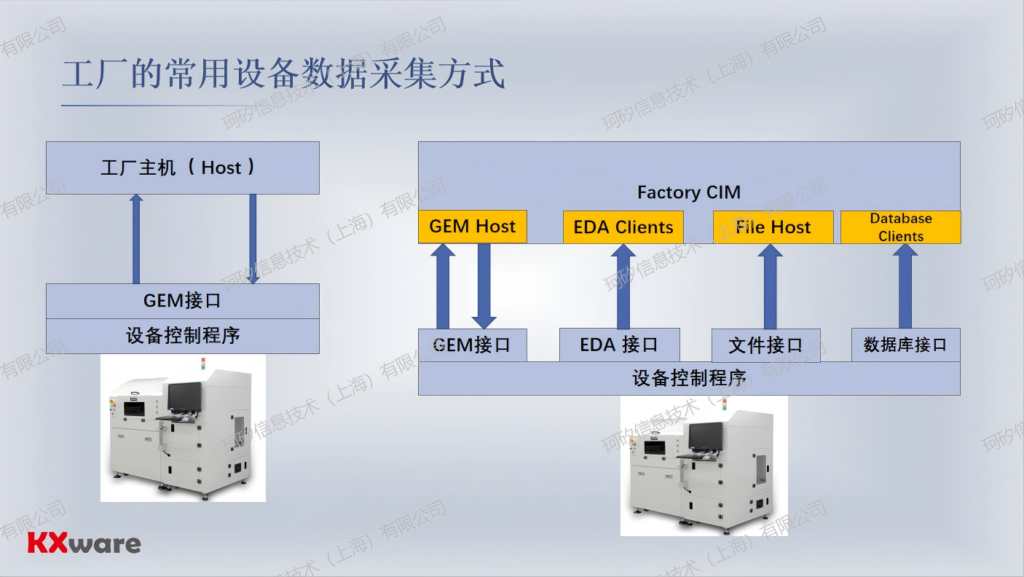
The EDA/Interface-A standard is a collection of standards, including:
Main Standards
- E120: Common Equipment Model
- E125: Equipment Self-Description Specification
- E132: Client Authentication and Authorization Specification
- E134: Data Collection Management Standard
Supporting Standards
- E128 XML Message Structures Specification
- E138 XML Specification for Semiconductor Common Components
- E164 EDA Common Metadata Specification (EDA Common Metadata, Freeze II Optional)
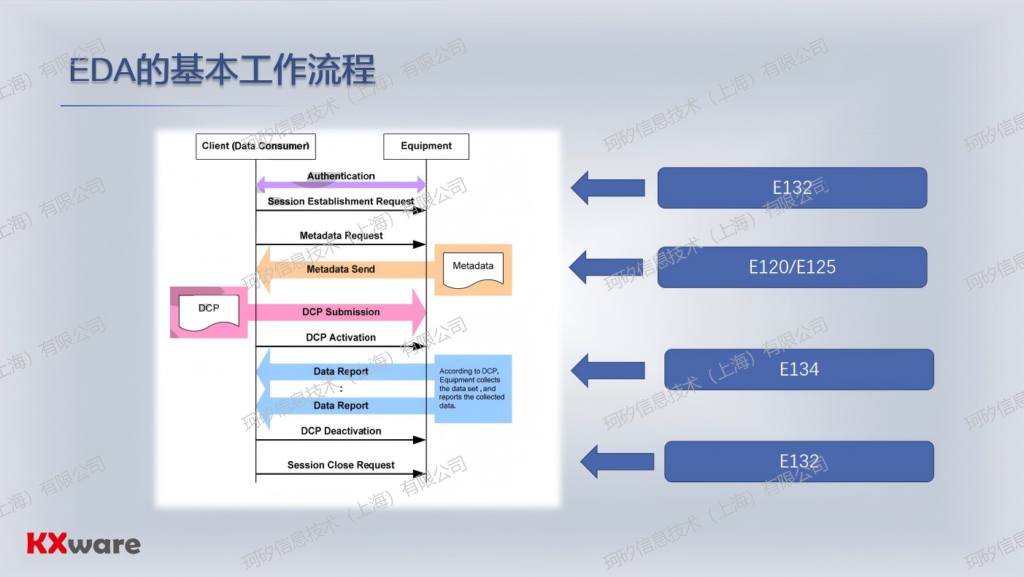
To ensure compatibility between clients and devices, it is necessary to freeze the standard versions to guarantee interoperability of underlying component standards (E120, E125, E132, E134). As of now, the freeze status for the EDA/Interface-A series standards is as follows.
- Freeze I, also known as Interface-A 1105
- Freeze II, also known as Interface-A 0710
- Freeze III, under development
KXEDA is software development kit for the EDA/Interface-A standard independently developed by Kxware. Designed for semiconductor equipment manufacturers, KXEDA encapsulates the complex details of the SEMI EDA standard, enabling rapid development of EDA server interfaces compliant with industry specifications. It meets the equipment qualification requirements of major domestic and overseas 300mm wafer fabs and advanced packaging production lines, significantly reducing development, testing, and maintenance costs.
KXEDA fully supports EDA Freeze I and Freeze II, with production‑proven mainstream Freeze II as its core compatible version. KXEDA includes configurable SECS GEM/GEM300/HB4/PV protocol-definition models, enabling bidirectional association and mapping between traditional GEM data models and EDA metadata, thereby establishing a seamless data migration pathway from the SECS GEM standard to the new EDA standard.
KXEDA’s core features include:
- Complete EDA interface implementation
It delivers a full‑suite implementation of E120/E125/E132/E134 Web Service interfaces, covering CEM device modeling, metadata publishing, session lifecycle management, ACL access control, DCP data collection plan lifecycle management, and event/exception/parameter tracking and reporting, and supporting multiple clients to simultaneously connect and retrieve device data.
- Device metadata self-description
It supports building a complete CEM object model (including Equipment, Module, Subsystem, IODevice, etc.), and externally exposes metadata such as device physical architecture, state machines, parameters, events, exceptions, data types, and measurement units. The factory-side EDA client can automatically identify device capabilities and data items without needing to refer to device manuals.
- Flexible DCP (Data Collection Plan)
It supports client‑side distribution, activation, deactivation, and deletion of DCP data collection plans; supports multiple collection modes including periodic polling, event‑triggered, and condition‑triggered collection. It features performance‑monitoring capabilities and proactively pushes performance alert notifications to clients when data collection load exceeds predefined thresholds.
- Secure Sessions and Access Control
It implements the E132 authentication and authorization framework, including session establishment, session keep-alive (SessionPing), session termination, ACL access control lists, and a role-based permission system, enabling fine-grained control over different clients’ access to device data and ensuring secure device communication. ‑
- Supporting Development tools and Examples
- It provides complete device sample code to help developers quickly understand standard logic and accelerate project integration.
- The KXEDATester test client is provided for interface debugging, DCP configuration distribution, and data reception verification, supporting both internal self-testing and on-site joint debugging at wafer fabrication plants.